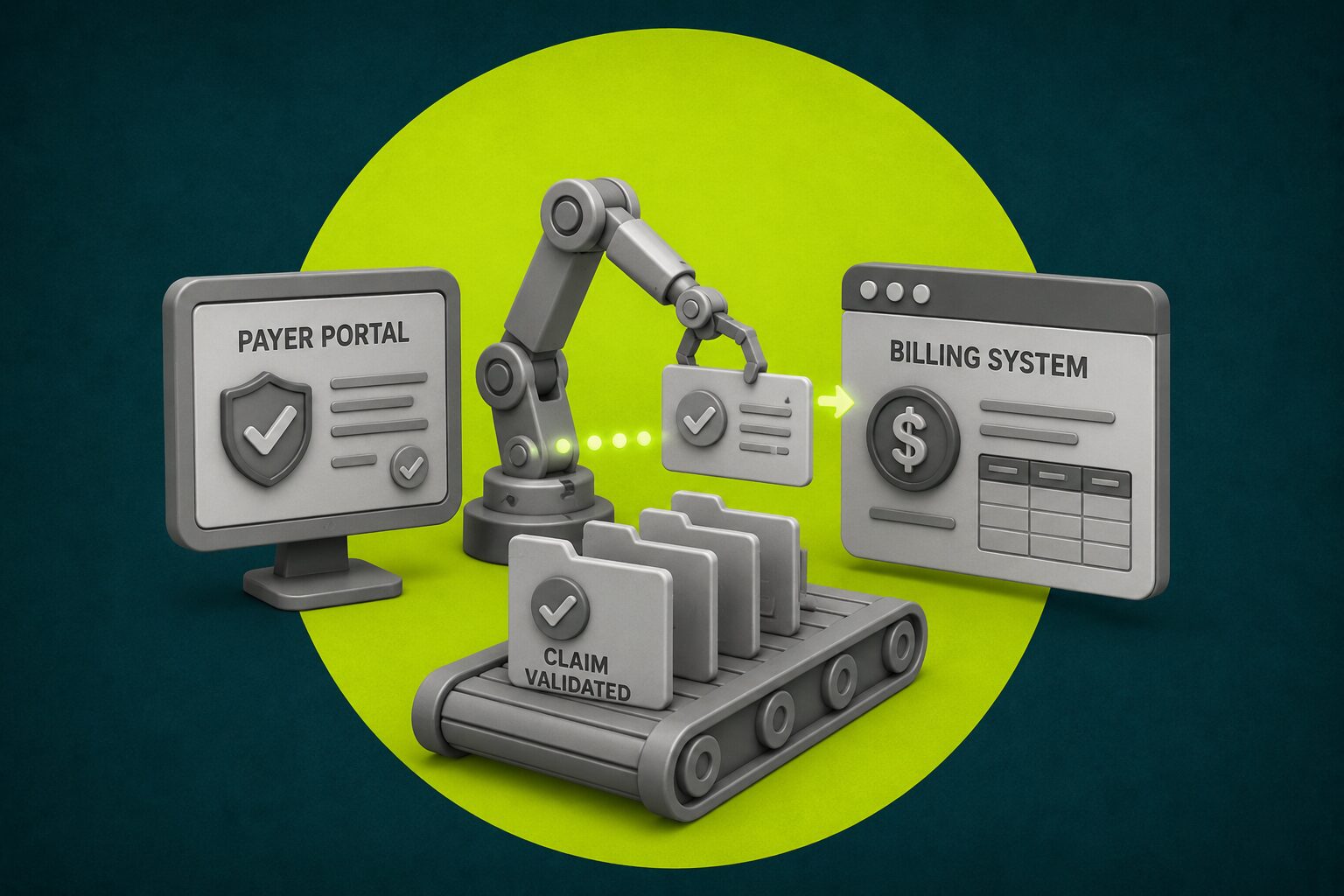
Discover how a leading healthcare organization eliminated manual claim status checks, reduced processing time by 80%, and freed their team to focus on patient outcomes.
In the first phase of this automation journey, SimpliSmart helped a healthcare services provider eliminate manual claim status lookups by automating payer portal verification at scale. While that solution removed a major operational bottleneck, one manual step remained.
In Phase Two, the focus shifted from retrieving claim status data to seamlessly integrating it into billing systems — completing the transition to a truly end-to-end, touchless revenue cycle workflow.
A mid-sized healthcare services provider operating in the home infusion and specialty pharmacy space relies on accurate, timely claim processing to support patient care and maintain healthy cash flow. After automating claim status lookups through payer portals, the organization sought to further reduce manual effort, eliminate downstream risk, and modernize revenue cycle operations — without disrupting existing technology.
Although claim status verification had been automated, operational friction persisted downstream. Once claim statuses were retrieved and validated, staff still had to manually update internal pharmacy and billing management systems. This introduced manual data entry burden requiring staff to re-enter validated status updates, high transaction volumes with approximately 28,100 claim lines per month, operational inefficiency where repetitive data entry consumed time and introduced errors, and revenue cycle risk where delays or inaccuracies slowed billing and reimbursement.
Automated claim status integration extends AI-enabled automated workflows beyond payer portals and into billing systems of record. Instead of relying on APIs or system changes, the automation securely interacts with existing pharmacy and billing applications — updating claim statuses just as a human would, but faster and with complete consistency.
Using Microsoft Power Platform, SimpliSmart implemented an unattended automation that transfers validated claim status data directly into billing systems — without manual intervention or platform modifications. The result was a seamless, touchless workflow that reduced risk while accelerating revenue cycle performance.
Ready to automate?
Find your best automation opportunities
Get a free, no-obligation assessment from our team of automation specialists.
Take the Free Assessment